George Zweig (b. 1937)
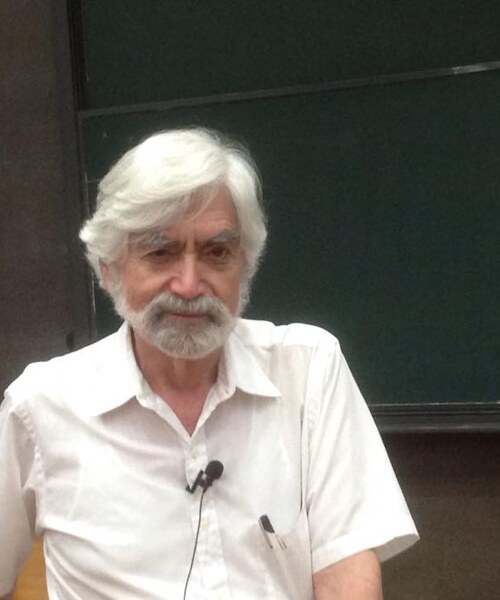
↑ All People | Featured in: Important People | Murray Gell-Mann
Russian-American physicist who proposed quarks independently of Gell-Mann in 1964 and was punished for it. Later left physics for neuroscience.
History
Born in Moscow to a Jewish family that emigrated to the United States via Vienna. Undergraduate at Michigan, PhD at Caltech in 1964 under Feynman. Spent the year of his thesis at CERN as a postdoc, which is where he wrote the quark papers.
He moved between physics, neurobiology, and finance over a long career. Joined Los Alamos as a senior physicist, then turned to the auditory system — modeling how the cochlea performs frequency analysis — and produced original work in signal processing. In the 2000s he applied his pattern-recognition tools to financial markets.
How He Thought
A model-builder. Where Gell-Mann came at hadrons through abstract group theory, Zweig came at them through concrete constituents — physical building blocks called aces that combined to make every observed particle. Same predictions, different language, more visualizable.
His instinct was that if a model worked, the constituents were probably real. Gell-Mann was more cautious — he hedged quarks as a "mathematical convenience" for years. Zweig believed his aces from the start.
What He Did
In 1964, at CERN, he wrote two papers proposing that hadrons are bound states of three fundamental particles he called aces, with fractional electric charge. The framework was equivalent to Gell-Mann’s quarks — same content, same predictions — and arrived independently within months.
CERN refused to publish his papers in the standard journals; they appeared only as CERN preprints. Senior physicists thought fractional charge was absurd. The reaction Zweig later described: he was treated as a charlatan. A respected physicist told him that quarks were "the work of a madman."
When deep inelastic scattering at SLAC confirmed point-like constituents inside protons, Gell-Mann’s name was on the theory and Zweig was a footnote. Feynman lobbied repeatedly for him to share Gell-Mann’s recognition; the Nobel never came. The history is generally fair to Zweig now, but the asymmetry stuck during the years it mattered.