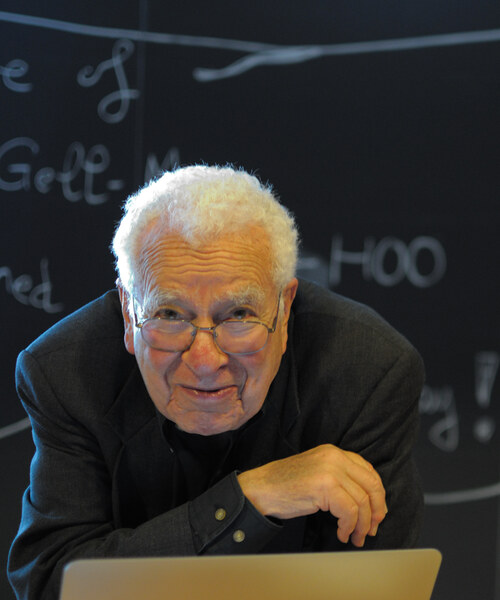
Murray Gell-Mann (1929-2019)
↑ All People | Featured in: Important People | George Zweig · John Dalton
American theoretical physicist. Imposed order on the particle zoo of the 1950s and 1960s, predicted the quark, and named most of the things he discovered with words borrowed from literature.
History
Born in Manhattan to Austrian-Jewish immigrants. Read voraciously from childhood — linguistics, archaeology, ornithology, ancient history. Entered Yale at 15, PhD from MIT at 21. Faculty at Caltech from 1955, working alongside Feynman — the two were rivals and intellectual sparring partners for decades. Won the 1969 Nobel Prize in Physics, alone, for the classification of elementary particles.
Outside physics he co-founded the Santa Fe Institute (1984), the seed of modern complexity science.
How He Thought
Gell-Mann’s defining instinct was the search for hidden symmetry. By the late 1950s, accelerators were producing dozens of new particles — kaons, pions, hyperons, resonances — with no obvious organizing principle. Most physicists treated this as a mess to be catalogued. Gell-Mann treated it as a code to be cracked.
He was famously erudite and famously prickly. He named his particles with care and bullied others into using the names: strangeness for the conserved quantity behind a class of decays, the Eightfold Way for his classification scheme (after the Buddhist path), quark from a line in Joyce’s Finnegans Wake — "Three quarks for Muster Mark."
What He Did
In 1961 he applied the group theory of SU(3) to the hadrons and got them to fall into geometric patterns — octets and decuplets. The Eightfold Way. One slot in the decuplet was empty; he predicted a particle, the Ω⁻, with specific mass, charge, and strangeness. It was found at Brookhaven in 1964 with exactly those properties.
In 1964 he and George Zweig proposed independently that hadrons are built from smaller, fractionally charged particles. Gell-Mann’s were quarks — up, down, strange, with charges +⅔, -⅓, -⅓. Zweig’s were aces; his version was treated as a charlatan’s invention. Gell-Mann’s version, hedged at first as a "mathematical convenience," became real when deep inelastic scattering at SLAC (1967-73) showed protons contained point-like objects inside.
A proton is uud. A neutron is udd. Three more flavors followed — charm, bottom, top — but the framework was Gell-Mann’s.