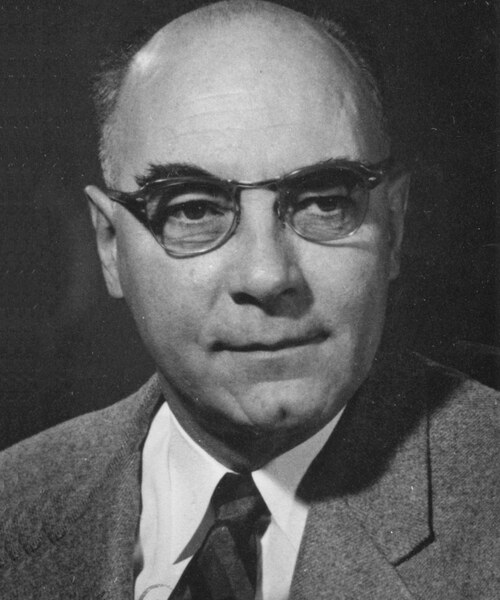
Carl Anderson (1905-1991)
↑ All People | Featured in: Important People | Paul Dirac · Murray Gell-Mann
American experimental physicist. Found the positron in cosmic ray photographs at age 27 and the muon a few years later. Spent his entire career at Caltech.
History
Born in New York City to Swedish immigrant parents, raised in Los Angeles. Undergraduate and PhD at Caltech, working under Robert Millikan on cosmic rays. Stayed at Caltech as faculty for the rest of his life. Won the 1936 Nobel Prize in Physics at age 31, jointly with Victor Hess (who discovered cosmic rays). One of the youngest Nobel laureates of the 20th century.
How He Thought
A photograph reader. Anderson’s instrument was a cloud chamber inside a strong magnet — charged particles leave curved tracks, and the curvature tells you the sign of the charge and the momentum. He took thousands of photographs and developed an eye for what was strange.
He did not start out looking for antimatter. He was studying the energies and species of particles in cosmic rays. The positron showed up because he was paying attention to a track that didn’t fit any known particle.
What He Did
In August 1932 he photographed a track in his cloud chamber that curved the wrong way. The mass and ionization matched an electron, but the curvature in the magnetic field corresponded to a positive charge. To rule out the possibility that it was an electron moving the other direction, he had inserted a 6 mm lead plate across the chamber: a particle slows down passing through it, so the curvature should tighten on the exit side. It did, in the direction that fixed the particle as moving downward and positive.
He published "The Positive Electron" in Physical Review in 1933. First antimatter particle ever observed — and exactly what Dirac’s equation had demanded four years earlier.
In 1936, with his student Seth Neddermeyer, he discovered the muon in cosmic rays — a particle 200 times heavier than the electron with otherwise identical properties. I.I. Rabi reportedly reacted with: "Who ordered that?" The muon turned out to be the first hint of the second generation of leptons.