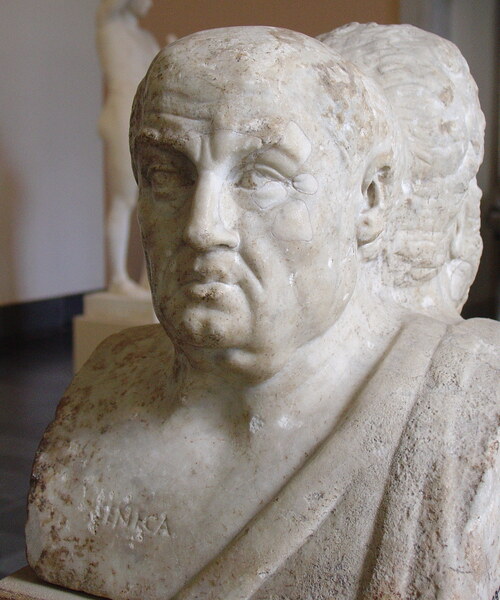
Seneca of Corduba (4 BCE - 65 CE)
Biography
Synopsis
Lucius Annaeus Seneca the Younger (c. 4 BC – AD 65), commonly known as Seneca, was an Ancient Roman Stoic philosopher, statesman, and dramatist.
Life
Seneca was born in Hispania and educated in rhetoric and philosophy in Rome. In AD 41, Emperor Claudius exiled him to the island of Corsica. He was recalled in 49 to serve as a tutor to the future emperor Nero. When Nero took the throne in 54, Seneca became his trusted advisor. For the first five years of Nero’s reign, Seneca and the praetorian prefect Sextus Afranius Burrus provided effective government.
However, Seneca’s influence waned over time. In 65, he was ordered to commit forced suicide for his alleged involvement in a conspiracy to assassinate Nero. His calm and Stoic death has been depicted in many paintings throughout history.
Works
Seneca was a prolific writer, and his works are a key source for ancient Stoicism. His philosophical prose includes 12 essays and 124 letters on moral issues. He also wrote several plays, all of which were tragedies, including his well-known works, Medea, Thyestes, and Phaedra. Seneca’s writing had a significant influence on later generations, particularly during the Renaissance, where he was revered as a moral and literary master.
Early Life
Seneca was born in Córdoba, Spain, around 4 BC. His father, Seneca the Elder, was a famous rhetorician. Seneca was the second of three brothers, and his nephew was the poet Lucan.
He was brought to Rome at a young age to be educated in rhetoric and philosophy. His teachers included the Stoic Attalus and members of the School of the Sextii, who combined Stoicism with Pythagoreanism. Influenced by his teachers, Seneca became a vegetarian for a short period before his father persuaded him to stop.
Seneca suffered from poor health, likely asthma, and at one point, he was sent to Egypt to live with his aunt to recover. He returned to Rome around AD 31 and, with his aunt’s help, began a political career, being elected as a quaestor, which granted him a seat in the Roman Senate.
Journeys
Seneca’s early political career as a senator was successful, and he was praised for his speeches. However, he faced opposition from Emperor Caligula, who was so offended by Seneca’s oratorical skill that he ordered him to commit suicide. Seneca was spared only because Caligula was told he was already near death from an illness.
In AD 41, under the new emperor Claudius, Seneca was accused of adultery with Julia Livilla by Empress Messalina and was exiled to the island of Corsica. During his eight-year exile, he wrote two works: Consolation to Helvia, which was for his mother, and Consolation to Polybius, in which he flattered Claudius and hoped for a recall.
In AD 49, Seneca was recalled from exile through the influence of Claudius’s new wife, Agrippina, who appointed him as tutor to her son, Nero. When Nero became emperor in 54, Seneca served as his advisor alongside the praetorian prefect Sextus Afranius Burrus. For the first five years, they provided competent government. Seneca wrote Nero’s speeches and a satirical play called Apocolocyntosis, which mocked the deification of Claudius.
However, Seneca and Burrus gradually lost their influence. They reluctantly agreed to the murder of Agrippina in 59. Seneca also faced public attacks from a senator named Publius Suillius Rufus, who accused him of accumulating immense wealth through usury and corruption. In response, Seneca had Suillius exiled, but the accusations highlighted the criticism Seneca faced for his great wealth. He defended his wealth in the philosophical work De Vita Beata, arguing that a philosopher could possess wealth as long as it was acquired and used properly.
Old Days and Death
After Burrus died in AD 62, Seneca’s influence over Nero rapidly declined. He tried to retire twice but was refused by Nero. He became increasingly absent from court and spent his final years on his country estates. During this time, he wrote two of his most important works: Naturales quaestiones, a type of encyclopedia of the natural world, and his Letters to Lucilius, which documented his philosophical thoughts.
In AD 65, Seneca was implicated in the Pisonian conspiracy, a plot to assassinate Nero. Although his involvement is doubted, Nero ordered him to commit suicide. Following tradition, Seneca severed several veins to bleed to death. His wife, Pompeia Paulina, attempted to join him but was saved by Nero’s order. Seneca’s death was slow due to his old age, and even after drinking poison, it was not fatal. To speed up the process and ease his pain, he entered a warm bath and died from suffocation by the steam. He was then cremated without a formal funeral.
Philosophy
As a major philosopher of the Roman Imperial Period, Seneca’s most significant contribution was to the school of Stoicism. His writings are highly accessible and provide a crucial body of primary material for understanding ancient Stoic thought.
Philosophical Works
Seneca’s philosophical works mainly focus on ethics, although one work, Naturales Quaestiones, explores the natural world. He drew heavily from earlier Stoics such as Zeno, Cleanthes, and Chrysippus, and he also frequently cited the Epicurean philosopher Epicurus for his ethical maxims.
Seneca saw philosophy as a remedy for life’s challenges. He believed that destructive emotions like anger and grief must be uprooted or controlled by reason. His philosophy also emphasized the importance of confronting one’s own mortality and being prepared to face death.
His philosophical letters, particularly the Letters to Lucilius, offer a blend of ethical theory and practical advice. In these works, Seneca discusses a range of topics, including:
-
The proper use of wealth and the willingness to practice poverty.
-
The value of friendship.
-
The importance of benefiting others.
-
The acceptance of adversity and the belief that the universe is governed by a rational providence for the best.
Beliefs (from Anton’s Stoics of Greece research)
-
Habits and Routines
“Life without design is erratic.” — Seneca -
Treat the Body Rigorously
“We treat the body rigorously so that it is not disobedient to the mind.” — Seneca -
Work on Yourself a Little Each Day
“Each day, acquire something that will fortify you against poverty, death, or misfortune.” — Seneca, Letters to Lucilius ** -
Go to Sleep and Get Good Rest
“Eventually, the mind will break as surely as the anvil breaks the hammer.” — Seneca -
Premeditatio Malorum (Negative Visualization)
“The unexpected blow lands heaviest.” — Seneca -
Memento Mori (Remember Death)
“You will not live forever. Remember death.” — A core Stoic theme
Beliefs (from Anton’s Stoics of Greece research)
-
Habits and Routines
“Life without design is erratic.” — Seneca -
Treat the Body Rigorously
“We treat the body rigorously so that it is not disobedient to the mind.” — Seneca -
Work on Yourself a Little Each Day
“Each day, acquire something that will fortify you against poverty, death, or misfortune.” — Seneca, Letters to Lucilius ** -
Go to Sleep and Get Good Rest
“Eventually, the mind will break as surely as the anvil breaks the hammer.” — Seneca -
Premeditatio Malorum (Negative Visualization)
“The unexpected blow lands heaviest.” — Seneca -
Memento Mori (Remember Death)
“You will not live forever. Remember death.” — A core Stoic theme