Pythagoras of Samos (570-495 BCE)
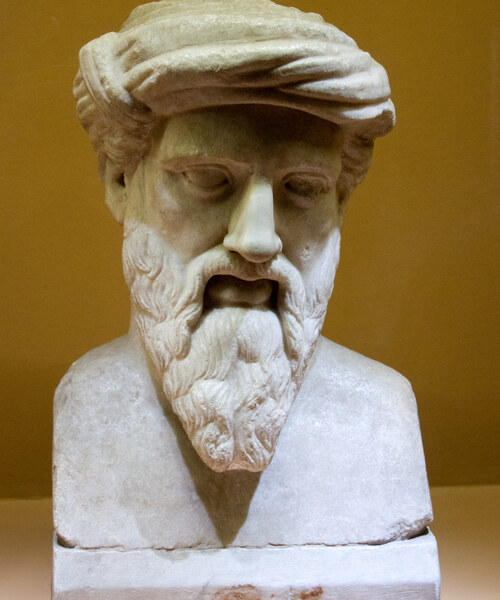
An Autographical Review
There is not a single detail in the life of Pythagoras that stands uncontradicted. But it is possible, from a more or less critical selection of the data, to construct a plausible account.
Early life
As to the date of his birth, Aristoxenus stated that Pythagoras left Samos in the reign of Polycrates, at the age of 40, which would give a date of birth around 570 B.C
Herodotus and Isocrates agree that Pythagoras was the son of Mnesarchus, and that he was born on the Greek island of Samos in the eastern Aegean. Mnesarchus is said to have been a gem-engraver or a wealthy merchant,but his ancestry is disputed and unclear. Apollonius of Tyana writes that Pythagoras’s mother was Pythaïs, a woman who was said to be a descendant of Ancaeus, the mythical founder of Samos.
During Pythagoras’s formative years, Samos was a thriving cultural hub known for its feats of advanced architectural engineering, including the building of the Tunnel of Eupalinos, and for its riotous festival culture. It was a major center of trade in the Aegean where traders brought goods from the Near East. According to Christiane L. Joost-Gaugier, these traders almost certainly brought with them Near Eastern ideas and traditions. Pythagoras’s early life also coincided with the flowering of early Ionian natural philosophy. He was a contemporary of the philosophers Anaximander, Anaximenes, and the historian Hecataeus, all of whom lived in Miletus, across the sea from Samos.
Travels
Ancient scholars believed that Pythagoras, a key figure in Archaic Greece, gained his unusual ideas from extensive travels. They claimed he learned from various cultures, including those in the Levant and Mesopotamia, even from figures like Pharaoh Amasis II in Egypt, the Magi or Zoroaster in Persia, the Phoenicians (arithmetic), and the Chaldeans (astronomy). Some even said he studied with Jews, and much later, with sages in India, and even the Celts and Iberians.
Greek Influences
Despite the tales of foreign travel, Pythagoras was also said to have studied with Greek thinkers. Many sources mention Pherecydes of Syros as his most frequent teacher, noting similarities in their views on the soul and reincarnation. Other alleged teachers include Epimenides, Hermodamas of Samos, Bias of Priene, Thales, and Anaximander.
Following Croton’s decisive victory over Sybaris in around 510 BC, Pythagoras’s followers came into conflict with supporters of democracy, and their meeting houses were burned. Pythagoras may have been killed during this persecution, or he may have escaped to Metapontum and died there.
Life in Croton
Around 530 BC, at about age 40, Pythagoras left his home island of Samos. While some say he left due to the tyranny of Polycrates, others suggest it was because of his popularity and overwhelming public duties. He settled in Croton (modern Crotone) in what is now southern Italy, where he quickly gained political influence, advising the city’s elites. He also established a renowned school, the "semicircle," where important public matters were debated.
Family and Death
Pythagoras reportedly had four children: Telauges, Mnesarchus, Myia, and Arignote. The famous wrestler Milo of Croton was said to be a close associate, even saving Pythagoras’s life once.
Pythagoras’s teachings on dedication are credited with Croton’s victory over Sybaris in 510 BC. However, after this victory, a conflict arose when Pythagoreans rejected a proposed democratic constitution. This led to an attack on the Pythagoreans, possibly at Milo’s house, where the building was set on fire and many members died.
Teachings
Metempsychosis
While the exact details of Pythagoras’s teachings are unclear, some of his main ideas can be outlined. A central belief was metempsychosis, or the reincarnation of the soul. He taught that all souls are immortal and are transferred into a new body after death. The philosopher Xenophanes, a contemporary of Pythagoras, joked about this idea in a poem, describing Pythagoras stopping someone from beating a dog because he recognized the voice of a dead friend in its cries.
It was also claimed that Pythagoras could remember his past lives in great detail. One story says he had four previous incarnations as a son of Hermes, a hero in the Trojan War, a philosopher, and a fisherman. Another tale even suggests he was a beautiful courtesan in a past life.
Numerology and Music
Later followers of Pythagoras, called Pythagoreans, were the first to develop the science of mathematics. They believed that the principles of math were the principles of everything.
Pythagoras is also credited with the idea of the "harmony of the spheres"—the belief that the planets and stars move according to mathematical equations that create a kind of inaudible music. Modern scholars, however, argue that these ideas about numbers and music were likely developed by a later Pythagorean philosopher named Philolaus of Croton.
For the Pythagoreans, the tetractys, a triangular symbol of four rows that adds up to the number ten, was a sacred symbol of mystical importance. They even swore oaths by it.
It’s important not to confuse these complex ancient ideas with modern "Pythagorean numerology," which is a simplified technique for reducing a name or word to a single number
Discovery’s & Feats
He was reputedly the first man to call himself a philosopher ("lover of wisdom").
Pythagoras influenced Plato whose dialogues (especially Timaeus) exhibit Pythagorean ideas.
Pythagoras was credited with mathematical and scientific discoveries, such as the Pythagorean theorem, Pythagorean tuning, the five regular solids, the theory of proportions, the sphericity of the Earth, the identity of the morning and evening stars as the planet Venus, and the division of the globe into five climatic zones.
Historians debate whether Pythagoras made these discoveries and pronouncements, as some of the accomplishments credited to him likely originated earlier or were made by his colleagues or successors, such as Hippasus and Philolaus.
In Music, Astronomy, and Beyond Legend says Pythagoras discovered that musical notes could be translated into mathematical ratios by observing blacksmiths' hammers. This led to the concept of Pythagorean tuning.
In astronomy, Pythagoras and his contemporary Parmenides were credited with being the first to suggest the Earth was spherical and to identify the morning and evening stars as the same object (Venus). However, Parmenides likely made these discoveries first.
Beliefs
The teaching most securely identified with Pythagoras is the "transmigration of souls" or metempsychosis, which holds that every soul is immortal and, upon death, enters into a new body.
The Pythagorean Way of Life
Pythagoras founded a unique community in Croton, often described as a "school" but resembling a monastery. His followers, called Pythagoreans, lived a communal lifestyle, sharing all their possessions and dedicating themselves to Pythagoras’s religious and philosophical teachings. They even ate meals together, similar to the Spartans, and lived by the motto, "All things in common among friends."
Their main goal was for the soul to achieve a divine state and escape the cycle of reincarnation. The Pythagoreans believed music was a powerful tool for purifying the soul, much like medicine purified the body. They also emphasized physical activity, including therapeutic dancing, daily walks, and athletics, and practiced daily contemplation.
Rules and Prohibitions
Pythagorean teachings were called "symbols," and new members took a vow of silence not to reveal these to outsiders. Those who broke the rules were expelled, and their former comrades would treat them as if they had died.
Many "oral sayings" of Pythagoras survived, providing guidance on sacrifices, honoring gods, and burial practices. These often stressed ritual purity and avoiding defilement. Some sayings were quite obscure, like not breaking bread or poking fires with swords, and their exact meanings are still debated, though later interpretations gave them philosophical significance.
Interestingly, Pythagoras was considered progressive for his time regarding women, and female members played an active role in his school.
The Pythagoreans also had strict dietary rules. It’s generally agreed they avoided fava beans and the meat of non-sacrificial animals. Some ancient writers claimed Pythagoras was a strict vegetarian, motivated by the belief in reincarnation, though others suggest he allowed some meat.
Legends About Pythagoras
Even during his lifetime, many legends grew around Pythagoras, portraying him as a supernatural figure and "wonder-worker." Stories claimed he had a golden thigh, which he supposedly showed at the Olympic Games. He was said to be able to be in two places at once and that a river once greeted him by name. Later Roman legends even called him the son of Apollo.
He was also known for his unusual appearance, dressing all in white with a golden wreath and Thracian-style trousers. Legends describe his remarkable ability to interact with animals, like biting a snake that bit him, or convincing a bull not to eat fava beans and a bear to stop harming living things. While these stories may seem fanciful, some scholars believe Pythagoras might have encouraged them himself to enhance his mystical image.