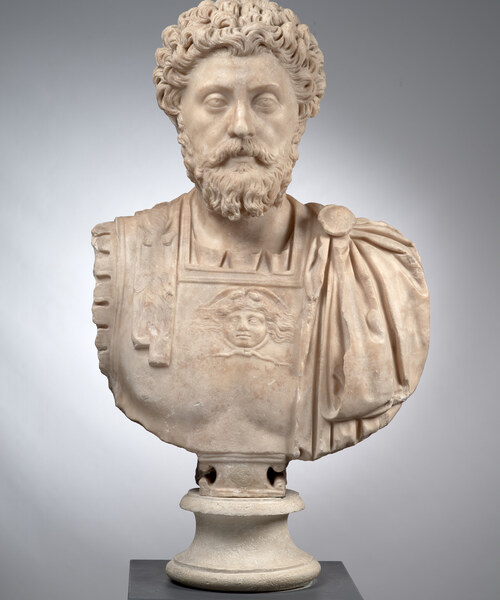
Marcus Aurelius of Rome (121-180 CE)
Biography
Synopsis
Marcus Aurelius Antoninus (AD 121–180) was a Roman emperor and a Stoic philosopher. He was one of the Five Good Emperors and the last emperor of the Pax Romana, a period of relative peace in the Roman Empire.
He was the son of Marcus Annius Verus and Domitia Calvilla. When his father died, he was raised by his mother and paternal grandfather. After the death of Emperor Hadrian’s heir, Hadrian adopted Marcus’s uncle, Antoninus Pius. In turn, Antoninus adopted Marcus and another young man named Lucius. When Antoninus Pius became emperor, Marcus became the heir to the throne. He studied under prominent tutors and married Antoninus’s daughter, Faustina, in AD 145.
After his uncle Antoninus died in AD 161, Marcus Aurelius became emperor alongside his adopted brother, Lucius Aurelius Verus. His reign was marked by significant military conflicts.
Major Events of His Reign
Military Conflicts: Marcus fought against the Parthian Empire in the East and against Germanic tribes like the Marcomanni and Quadi in the West during the Marcomannic Wars.
The Antonine Plague: A widespread plague broke out around AD 165, devastating the Roman Empire’s population. It is believed that his co-emperor, Lucius Verus, died from this plague in 169.
Succession: Marcus broke the tradition of the "Five Good Emperors" by naming his biological son, Commodus, as his successor.
Christian Persecution: The persecution of Christians increased during his reign, though his direct involvement is unlikely.
Legacy and Sources
Marcus Aurelius’s philosophical work, Meditations, remains one of the most important sources for understanding ancient Stoicism. His writings have been praised for centuries.
The primary sources for his life, such as the Historia Augusta and the writings of Cassius Dio, are often patchy and unreliable. However, his personal correspondence and his own Meditations provide some insight into his life and character. The Column of Marcus Aurelius and his Equestrian Statue still stand in Rome today.
Early Life
Marcus Aurelius was born in Rome on April 26, 121 AD. His birth name is debated, but he eventually became known by the name Marcus Aurelius Antoninus Augustus upon becoming emperor.
Family and Childhood
Marcus Aurelius’s family, the gens Annia, was of Italic origin but had settled in Spain. His father, Marcus Annius Verus (III), died when Marcus was three years old. He was raised by his mother, Domitia Lucilla Minor, and his paternal grandfather, Marcus Annius Verus (II). His mother’s family owned a large brick-making business and a villa in Rome on the Caelian Hill, where Marcus was born and raised.
From a young age, Marcus was interested in wrestling and boxing and joined the Salii, an ancient Roman priestly order. He was educated at home by a series of tutors. His painting teacher, Diognetus, was particularly influential, as he introduced Marcus to philosophy. At Diognetus’s urging, Marcus began to live as a philosopher, adopting a simple Greek cloak and sleeping on the ground.
In late 136, after a serious illness, Emperor Hadrian chose Lucius Ceionius Commodus to be his adopted son and successor. However, Lucius Aelius Caesar, as he was renamed, died in early 138.
On January 24, 138, Hadrian chose Aurelius Antoninus, Marcus’s uncle by marriage, as his new successor. As part of the terms, Antoninus, in turn, adopted Marcus and Lucius Commodus, the son of the deceased Aelius Caesar. Marcus was renamed Marcus Aelius Aurelius Verus and was betrothed to Antoninus’s daughter, Faustina.
Marcus was appointed quaestor and began to take on more responsibilities, but he found court life challenging to reconcile with his philosophical studies. When Hadrian died on July 10, 138, Antoninus Pius became emperor.
Heir to the Throne (138–145)
Shortly after Hadrian’s death, Antoninus Pius had Marcus’s betrothal to Ceionia Fabia annulled so Marcus could marry his daughter, Faustina. Marcus was made consul for the second time in 145 and married Faustina that same year. They had a large family, but many of their children died in infancy, a grief Marcus reflected on in his writings.
He continued his education, training in oratory and philosophy with prominent tutors. While he had a close relationship with his rhetoric tutor, Marcus Cornelius Fronto, he ultimately favored philosophy, particularly the Stoicism taught by Quintus Junius Rusticus.
Marcus’s adopted brother, Lucius Commodus, also started his political career but had a very different personality, enjoying sports and games rather than intellectual pursuits.
Death of Antoninus Pius
As Antoninus Pius aged, Marcus took on more administrative duties. On March 7, 161, Antoninus died, passing the state on to Marcus. His final word was reported to be "equanimity," a Stoic virtue. His death marked the end of a long and peaceful reign.
Journeys
Following the death of Antoninus Pius in 161 AD, Marcus Aurelius became the sole ruler of the Roman Empire. The Senate offered him all the traditional imperial titles, but he refused to accept them unless his adoptive brother, Lucius Verus, received equal power. The Senate agreed, and for the first time in Roman history, the empire was ruled by two co-emperors.
Early Reign and Challenges
Although Lucius and Marcus were nominal equals, Marcus held more authority and was the senior emperor. The two emperors promised a large donative, or gift, to the Praetorian Guard as a form of insurance against potential military unrest.
Shortly after their accession, the city of Rome was struck by a severe flood of the Tiber River, which led to a famine. Marcus and Lucius personally oversaw the crisis and provided aid to the people. Marcus also began to face immediate military crises, as a war with the Parthian Empire broke out.
War with Parthia (161–166)
The Parthian War began in 161 with a Parthian invasion of the Roman client state of Armenia. The initial Roman response was a disaster, with one legion being massacred. To manage the crisis, it was decided that Lucius would lead the war effort in person, though Marcus’s biographers suggest this was also to curb Lucius’s dissolute lifestyle. Lucius spent much of the campaign in Antioch, a city known for its pleasures.
The war was a success for Rome. The Roman forces captured the Armenian capital, Artaxata, and installed a new king. In 165, the Roman general Avidius Cassius led a successful invasion of Mesopotamia, culminating in the capture and sacking of the Parthian capital, Ctesiphon. Lucius and Marcus both took the title Parthicus Maximus to commemorate the victory.
War with Germanic Tribes (166–180)
After the Parthian War, the Roman Empire faced a new threat on its northern frontier. Starting around 166, various Germanic tribes, including the Marcomanni and Quadi, began launching raids across the Danube. Marcus, who had little military experience before becoming emperor, was forced to confront these new enemies. The prolonged and difficult conflict became known as the Marcomannic Wars.
In 168, Marcus and Lucius embarked on a new military campaign. However, Lucius fell ill and died on his way back to Rome, likely from the Antonine Plague, which had broken out during the Parthian War and was now devastating the Roman population.
Legacy
Throughout his reign, Marcus Aurelius was deeply involved in legal and administrative work, earning a reputation as a wise and just emperor. His reign also saw the start of the Antonine Plague, a widespread pandemic that ravaged the empire. It is possible that Roman contact with the Han dynasty of China led to the plague’s arrival, which would have had devastating consequences for the empire’s trade and population.
Old Days and Death
Marcus Aurelius died on March 17, 180, at the age of 58 in his military quarters. His death is often considered to mark the end of the Pax Romana. He was immediately deified, and his ashes were returned to Rome.
succession and Legacy
Marcus Aurelius was succeeded by his son, Commodus, whom he had co-ruled with since 177. This was only the second time a biological son had succeeded his father as emperor. Historians like Cassius Dio criticized this decision, viewing Commodus’s reign as a decline from the "golden kingdom" of Marcus to one of "iron and rust." Other historians, like Michael Grant, have argued that Marcus’s choice was practical, as selecting another heir would likely have led to a destructive civil war.
Relationship with Christians
The persecution of Christians seems to have increased during Marcus Aurelius’s reign, although the extent of his personal involvement is debated. In his Meditations, he mentions Christians once, criticizing what he saw as their theatrical willingness to die for their faith. A letter crediting a "rain miracle" to Christian prayer, which is attributed to Marcus, is widely considered to be a forgery.
Family
Marcus was married to Faustina the Younger, and they had at least 14 children, including two sets of twins. Only one son, Commodus, and four daughters survived him.
Philosophy
Meditations is a collection of personal writings by Marcus Aurelius that he wrote for his own guidance and self-improvement while on military campaigns between AD 170 and 180. The original title is unknown, but the work has since become one of the most celebrated philosophical texts of all time. It was a favorite of many later writers and thinkers, including John Stuart Mill and Goethe.
It is unknown how widely the work circulated after Marcus’s death, but it survived through the traditions of the Eastern Church. The first surviving quotes and references to the book appeared in the 10th century. Meditations was first published in 1558 in Zurich from a now-lost manuscript. The oldest complete copy is in the Vatican Library and dates to the 14th century.
Philosophical Legacy
During his lifetime and after his death, Marcus Aurelius was widely regarded as a philosopher king. The historian Herodian noted that Marcus proved his philosophical principles not just with words but with his "blameless character and temperate way of life." The historian Cassius Dio and Christian writers also gave him the title of "the philosopher."
Some historians consider his legacy tragic because his son and successor, Commodus, completely abandoned the Stoic values of self-restraint and duty that Marcus embodied.
Beliefs (from Anton’s Stoics of Greece research)
-
Don’t Procrastinate
“You could be good today. But instead, you choose tomorrow.” – Marcus Aurelius -
Wake Up Early
"At dawn, when you have trouble getting out of bed, tell yourself: I have to go to work as a human being." – Marcus Aurelius, Meditations Book 5 -
Don’t Overthink It
“Waste no more time arguing what a good man should be. Be one.” – Marcus Aurelius
Beliefs (from Anton’s Stoics of Greece research)
-
Don’t Procrastinate
“You could be good today. But instead, you choose tomorrow.” – Marcus Aurelius -
Wake Up Early
"At dawn, when you have trouble getting out of bed, tell yourself: I have to go to work as a human being." – Marcus Aurelius, Meditations Book 5 -
Don’t Overthink It
“Waste no more time arguing what a good man should be. Be one.” – Marcus Aurelius