Hans Geiger (1882-1945) and Ernest Marsden (1889-1970)
The hands behind Rutherford’s eyes. Geiger was a German physicist who later invented the Geiger counter (1928). Marsden was a 20-year-old undergraduate when Rutherford handed him the gold foil experiment as a project.
History
Geiger came to Manchester from Germany after a PhD in Erlangen. He worked with Rutherford on counting alpha particles — tedious, eye-straining work in a darkened room. After leaving Manchester he went back to Germany and developed the Geiger-Müller counter, which became the standard radiation detector and is still in use a century later. He stayed in Germany through both world wars; his lab was destroyed in WWII bombing.
Marsden was a New Zealander like Rutherford — this mattered, Rutherford liked his fellow countrymen. He arrived at Manchester as an undergraduate in 1909 and got handed the deflection-counting job almost immediately. After WWI he moved back to New Zealand and became one of the country’s most important scientific administrators, knighted in 1958.
How They Thought
Geiger had the patience of a clock. He could sit for hours in pitch-darkness, eye to a microscope, counting individual flashes on a zinc sulfide screen as alpha particles hit it. The discovery depended on this — the bounce-back was a 1-in-8,000 event, easy to miss if you weren’t watching every flash.
Marsden was young, fresh, didn’t yet know what was supposed to be impossible. When Rutherford suggested checking for back-scattered alpha particles — not because he expected anything, just to be thorough — Marsden actually looked. He saw flashes on the wrong side of the foil. A more experienced experimenter might have decided the apparatus was leaking.
The combination matters: Geiger’s patience plus Marsden’s willingness to believe an unexpected result.
What They Did
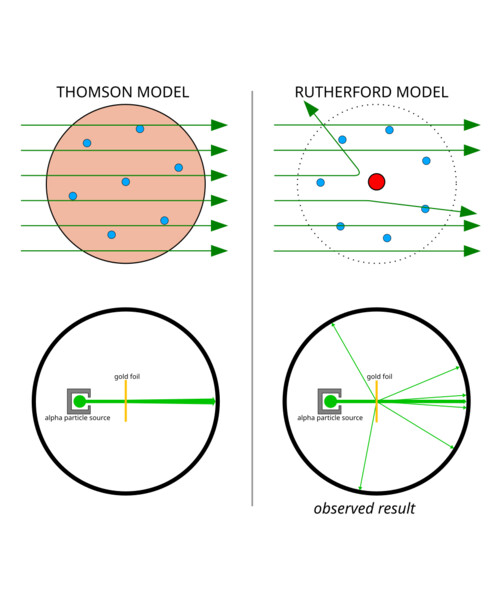
In 1909 they ran the experiment that would become known as Rutherford’s gold foil experiment. They aimed alpha particles from a radium source at a thin gold foil and counted scintillations on a zinc sulfide screen positioned at various angles around the foil.
The plum-pudding prediction: tiny deflections only. The result: most particles passed through, but ~1 in 8,000 deflected by more than 90 degrees. Some came almost straight back at the source.
They published this as "On a Diffuse Reflection of the α-Particles" in Proceedings of the Royal Society A (1909). Rutherford’s interpretation — the nucleus — followed in 1911. Without their data, no nucleus.
Geiger’s later invention of the Geiger counter (with Walther Müller) made every subsequent nuclear and particle experiment easier; it’s the workhorse instrument that turned counting individual particles from hours of eyestrain into an audible click.