Galileo Galilei (1564-1642)
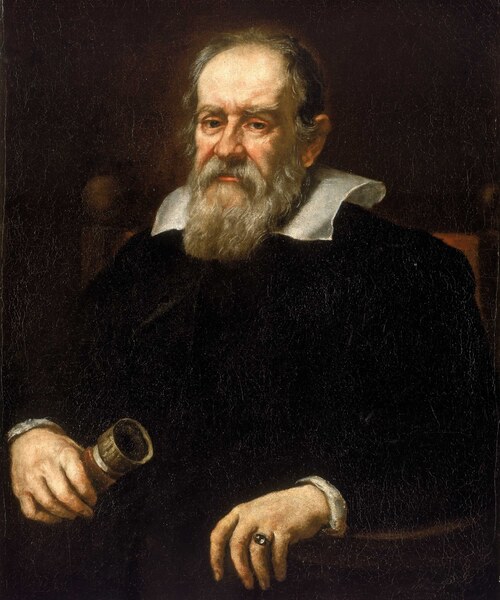
↑ All People | Featured in: On Particle · Important People | Isaac Newton · Pierre Gassendi
Slop
The man who made matter mathematical — and whose trial made atoms dangerous. Galileo held that the book of nature "is written in the language of mathematics," and in The Assayer (1623) he treated matter as tiny corpuscles, arguing that tastes, odors, and colors live in the senses of the observer, not in the particles themselves. His condemnation by the Inquisition in 1633 is the political backdrop of this whole story: afterward, defending atomism in Catholic Europe was dangerous, and it took Gassendi’s careful theological framing to make particles safe again for Newton’s generation.
Primary and secondary qualities:
Galileo separated the qualities that are really in the corpuscles — size, shape, position, motion — from the ones that exist only in the perceiver — taste, color, smell, heat. Heat, he argued, is not in the fire; it is what fast, fine particles do to our bodies. That is the same cut Democritus had made "by convention" two thousand years earlier, and the same one John Locke would formalize sixty years later. Galileo put it in the language of mathematics and experiment, which is part of why it carried.