Leonardo of Pisa, “Fibonacci” (c. 1170 - c. 1250)
Summary
Leonardo Bonacci (c. 1170 – c. 1240–50), commonly known as Fibonacci, was an Italian mathematician from the Republic of Pisa, considered to be "the most talented Western mathematician of the Middle Ages."
The name he is commonly called, Fibonacci, is first found in a modern source in a 1838 text by the Franco-Italian mathematician Guglielmo Libri and is short for filius Bonacci ('son of Bonacci'). However, even as early as 1506, Perizolo, a notary of the Holy Roman Empire, mentions him as "Lionardo Fibonacci."
Fibonacci popularized the Indo–Arabic numeral system in the Western world primarily through his composition in 1202 of Liber Abaci (Book of Calculation) and also introduced Europe to the sequence of Fibonacci numbers, which he used as an example in Liber Abaci.
An Autographical Review
Fibonacci was born around 1170 in Italy to Guglielmo, a merchant who directed a trading post in Bugia (modern-day Béjaïa, Algeria). Fibonacci was educated in Bugia, where he learned about the Hindu-Arabic numeral system.
He traveled the Mediterranean coast, studying various arithmetic systems used by merchants. He recognized the advantages of the Hindu-Arabic system over Roman numerals, particularly its place-value system for easier calculations. In 1202, he completed his influential work, Liber Abaci (The Book of Calculation), which played a key role in popularizing Hindu-Arabic numerals in Europe.
Fibonacci was a guest of Emperor Frederick II, who had a strong interest in mathematics and science. John of Palermo, a member of Frederick II’s court, challenged Fibonacci with mathematical problems based on Arab works. In 1240, the Republic of Pisa honored Fibonacci (referred to as Leonardo Bigollo) with a salary in recognition of his services as an advisor on accounting and instructor to citizens.
Fibonacci is believed to have died in Pisa between 1240 and 1250.
Discoveries/Achievements
Liber Abaci
In his 1202 book, Liber Abaci (Book of Calculation), Fibonacci introduced the Hindu-Arabic numeral system (the "method of the Indians") to Europe. This system, with its ten digits including zero and positional notation, offered significant advantages over Roman numerals. The book demonstrated its practical value for commercial purposes, such as bookkeeping, converting weights and measures, calculating interest, and money exchange. Liber Abaci was widely acclaimed and profoundly impacted European thought, simplifying business calculations and aiding the growth of banking and accounting.
While the original 1202 manuscript is lost, a 1228 copy details the numeral system and its comparison with others like Roman numerals. It also explains its applications in business, including currency conversion, profit calculation, and interest, alongside discussions on irrational and prime numbers.
Fibonacci Sequence
Liber Abaci is also notable for presenting and solving a problem concerning rabbit population growth under idealized conditions. The solution generated a sequence of numbers now known as Fibonacci numbers, where each number is the sum of the two preceding ones. Although Fibonacci’s Liber Abaci is the earliest known European description of this sequence, it had been described by Indian mathematicians as early as the sixth century. Fibonacci’s sequence typically started with 1, 2, 3… (omitting the modern 0 and first 1) and was calculated up to the thirteenth place (233) or occasionally the fourteenth (377). Fibonacci himself did not discuss the golden ratio in relation to this sequence.
Legacy
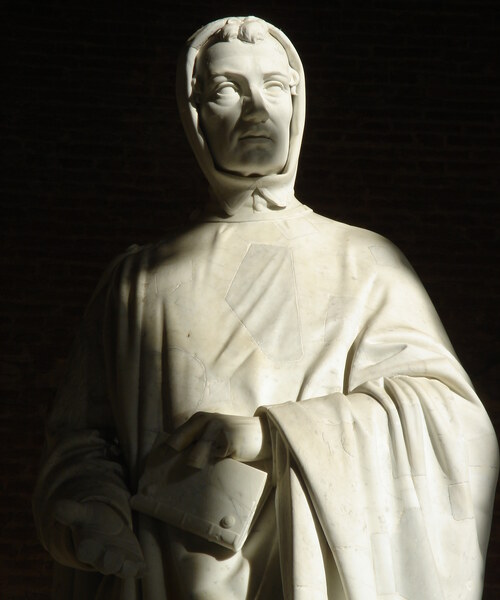
Fibonacci’s contributions have been recognized through various mathematical concepts named after him, such as the Brahmagupta–Fibonacci identity, the Fibonacci search technique, and the Pisano period. Beyond mathematics, the asteroid 6765 Fibonacci and the art rock band The Fibonaccis are named in his honor. A statue of Fibonacci stands in Pisa, located in the western gallery of the Camposanto.
Works
Fibonacci’s known works include:
-
Liber Abaci (1202): His seminal work on calculations, popularizing Hindu-Arabic numerals.
-
Practica Geometriae (1220): A comprehensive guide on surveying, measurement, and practical geometry.
-
Flos (1225): Contains solutions to mathematical problems posed by Johannes of Palermo.
-
Liber quadratorum ("The Book of Squares"): A work on Diophantine equations, dedicated to Emperor Frederick II.
-
Di minor guisa (lost): A treatise on commercial arithmetic.
-
Commentary on Book X of Euclid’s Elements (lost).