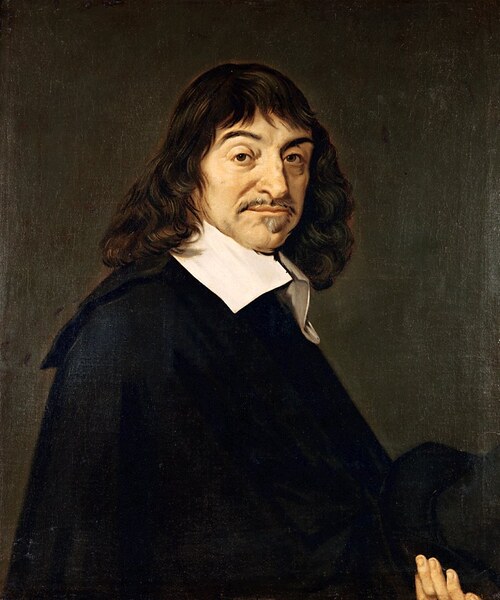
René Descartes (1596-1650)
↑ All People | Featured in: Important People | Pierre Gassendi
Slop
The one who said no to the void. Where the atomists split the world into atoms and empty space, Descartes denied that empty space could exist at all: matter went all the way down, packed without gaps, and motion happened as swirling vortices in a completely full universe — a plenum. He is the great opponent in this story, the mechanical philosophy without the void. He also handed mathematics a tool it still uses every day: analytic geometry, algebra and geometry fused onto a coordinate grid — the "Cartesian" plane.
Plenum versus void:
Leucippus invented atoms-plus-void to let change happen: things move because there is empty space to move into. Descartes refused the empty space. For him extension just is matter, so a truly empty space is a contradiction — the cosmos is packed solid, and motion is matter shoving matter in great whirlpools (vortices), which is how he explained the orbits of the planets. The void-versus-plenum argument ran for a century; Torricelli’s barometer and Newton’s mechanics eventually decided it for the void — but Descartes forced the atomists to actually defend the emptiness their whole picture depended on.